

Contacts and journeys
Find repeat contacts and inspect the queue transitions observed in the selected period.
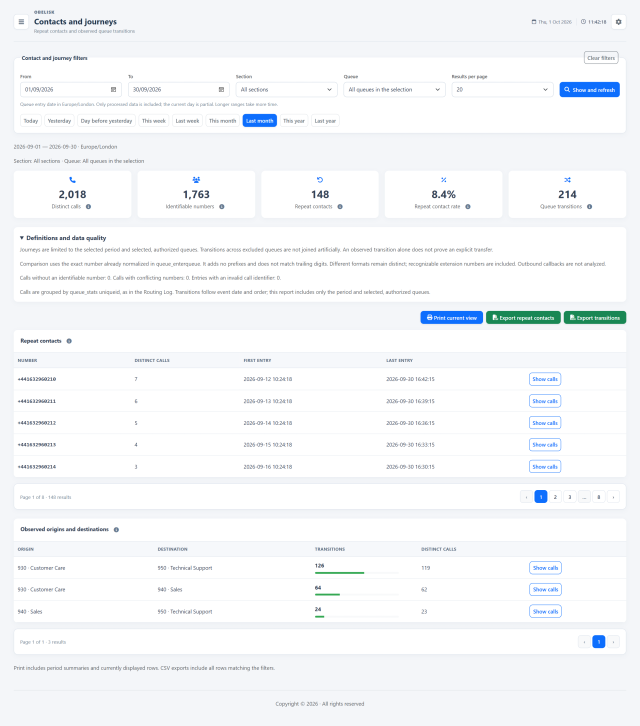
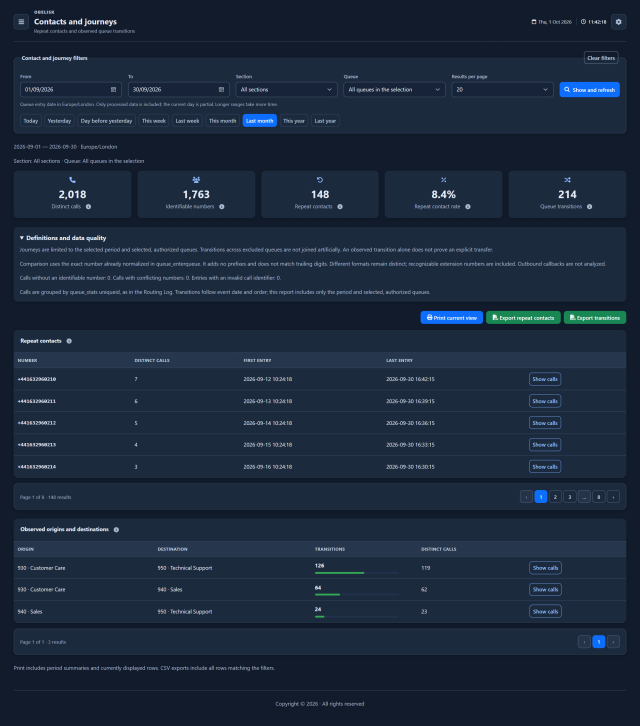
Slide the divider to compare the same workspace.
DarkKnow what to look for.
Calls, repeat contacts and queue transitions
Compare distinct calls, identifiable numbers, repeat contacts and queue transitions. The repeat-contact rate is the share of identifiable numbers associated with more than one call in the selected scope.
Understand the scope and quality of the data
The definitions explain how calls and normalised telephone numbers are linked within the selected period and queues. Counts for missing numbers, conflicting numbers and invalid identifiers make the basis of the analysis visible.
Inspect repeat contacts
Find numbers associated with at least two distinct calls, with their call count and first and last entry. Open the call list and continue to the Routing Log to examine each call in context.
Compare observed origins and destinations
For each queue-to-queue path, compare the number of transitions and the distinct calls involved. Open the related calls to understand the sequence of queue entries behind the aggregate.
Read the signal.
Choose the next step.
Separate a repeat contact from a long journey
A call that enters several queues remains one distinct call when the same call identifier links its entries. A number that calls again creates a repeat contact. Reading these together helps you separate movement within one conversation from the need to contact the service again.
Find a number with several contacts, inspect its first and last entry and open the individual call journeys. Use observed transitions to identify a pattern worth reviewing with the team.
Put it to work
Choose period and authorized queues to measure contact repetition using the normalized numbers in the call data.
Read chronological entries and passages between consecutive queues, with a direct path to the corresponding Routing call.
Export the complete filtered contact and journey results, or print the summaries and rows currently displayed.
What you can do
Measure observed contact patterns
Distinct calls, identifiable numbers, repeat contacts, repeat-contact rate and observed transitions.
Find returning numbers
Rank repeat contacts with first/last entry and open their individual call journeys.
Understand queue transitions
Inspect origins/destinations and transition frequency over the entire filtered result.
Open the individual journey
Drill through from chronological queue entries to Routing Log.
Export the broader view
Export all filtered repeat contacts or transitions; print current visible rows.
Read the detail with confidence
A number may represent several people, so this is not a unique-customer measure.
A number may represent several people, so this is not a unique-customer measure.
Only selected period and authorized queues are included
Only selected period and authorized queues are included; excluded queues are not bridged artificially.
Observed transition does not prove an explicit transfer.
Observed transition does not prove an explicit transfer.
Uses exact already-normalized stored numbers
Uses exact already-normalized stored numbers; does not analyze outbound callbacks.
Shares Routing permission and routing export/print controls.
Shares Routing permission and routing export/print controls.